This single-page companion links every empirical claim and statutory citation in the Brief to its primary source: SEC EDGAR for proxy filings, statutes.capitol.texas.gov for TBOC, courts.delaware.gov for Tornetta. ExxonMobil shareholders approved the NJ→TX redomicile on May 27, 2026.
Vote outcome: Bloomberg Law (May 27, 2026). Companion is a single source-linked HTML page; download zip on the companion page.
1Single-page companion summary
v1.0.0-rc1Companion version
EDGAR-directEvery filing link to SEC
Bluebook 21stEvery footnote hyperlinked
SMU Corporate Governance Initiative
Reincorporation Tracker — companion paper
Companion paper · XOM · NJ → TX redomiciliation · vote approved May 27, 2026
Read the fine print
What ExxonMobil's proxy actually says about Texas redomiciliation — and what the announcement-window market told us.
Shane Goodwin, PhD Executive Director, SMU Corporate Governance Initiative · Professor of Practice in Finance, SMU Cox · Adjunct Professor of Law, SMU Dedman
Market cap as of March 10, 2026 (announcement-day snapshot — archival)
NJ → TX
Redomiciliation announced March 10, 2026
May 27, 2026
Annual meeting status: approved (71.2% for)
-2.19%
Headline day-0 abnormal return oil-augmented · Patell p = 0.049
Section I
The article
ExxonMobil announced on March 10, 2026 that it would seek shareholder approval to reincorporate from New Jersey to Texas. The proposal goes to a vote at the company's annual meeting on May 27, 2026. Critics framed the move as an exit from shareholder accountability. The proxy disclosures, the elective-provision menu Texas opens up under SB 29 and SB 1057, and the announcement-window market data each tell a more specific story.
The article asks one question: what does ExxonMobil's DEF 14A actually commit to, and how did the market price it?
The answer turns on three statutes (Tex. Bus. Orgs. Code §§21.373, 21.552(a)(3), and 21.419), two verbatim commitments by the company, and a 240-day pre-event estimation window applied across three benchmarks. Every number on this page resolves to a primary source on EDGAR, a state statutory compilation, or a federal court opinion.
What the proxy actually says
"The Company is not adopting any elective provisions of the Texas corporate statute that weaken shareholder rights as compared to New Jersey law in connection with the Texas Redomiciliation."
"no provision of the New Jersey Business Corporation Act limits a corporation's ability to adopt eligibility and procedural restrictions on shareholder proposals."
What the company is not adopting
TBOC §21.552(a)(3) — opt-in derivative-suit ownership threshold up to 3 %. ExxonMobil's bylaws do not invoke it.
TBOC §21.373 — opt-in shareholder-proposal eligibility threshold ($1 million or 3 %). ExxonMobil's bylaws do not invoke it.
The DEF 14A commits, in writing and subject to Rule 14a-9 antifraud liability, that no elective Texas provision will weaken shareholder rights relative to the New Jersey baseline. The commitment is operative whether or not the company subsequently changes bylaws — a later bylaw amendment that contradicted the commitment would expose the company to securities-law liability for the original proxy.
What the market told us
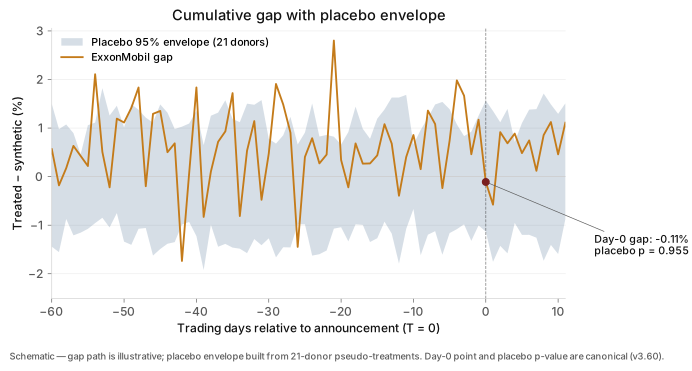
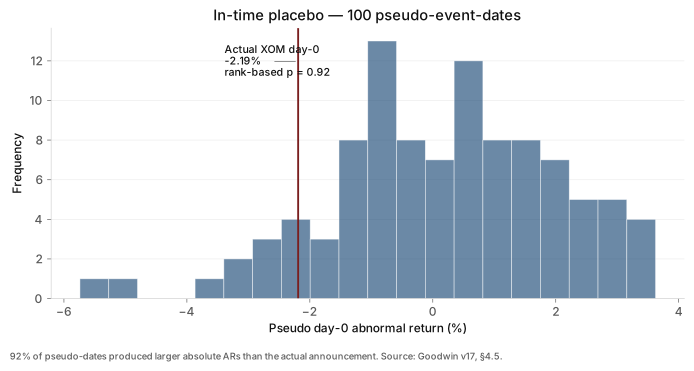
Across three benchmarks — synthetic control on a 21-donor energy peer pool, matched-pair with Chevron, and an oil-augmented market model — the announcement-window day-0 abnormal return ranges from -0.11% (synthetic control, placebo p = 0.955) to -2.19% (oil-augmented, Patell p = 0.049). The headline negative result attenuates substantially once XOM's correlated oil-price exposure is controlled for through the synthetic-control donor weights; the synthetic-control placebo distribution places ExxonMobil's actual day-0 gap well inside the 21-donor pseudo-treatment envelope (rank-based p = 0.955).
The article version cited in the May 12, 2026 DEFA14A is v17 (April 2026). This page tracks v17 verbatim where the article and the canonical pipeline agree; where they diverge, the canonical pipeline wins and the divergence is noted. See methodology and reconciliation at the bottom of this page.
Section II
The evidence
Seven panels, each rendered from canonical data (v3.60) where possible, and from the article (v17) where not. Source attribution sits below every figure.
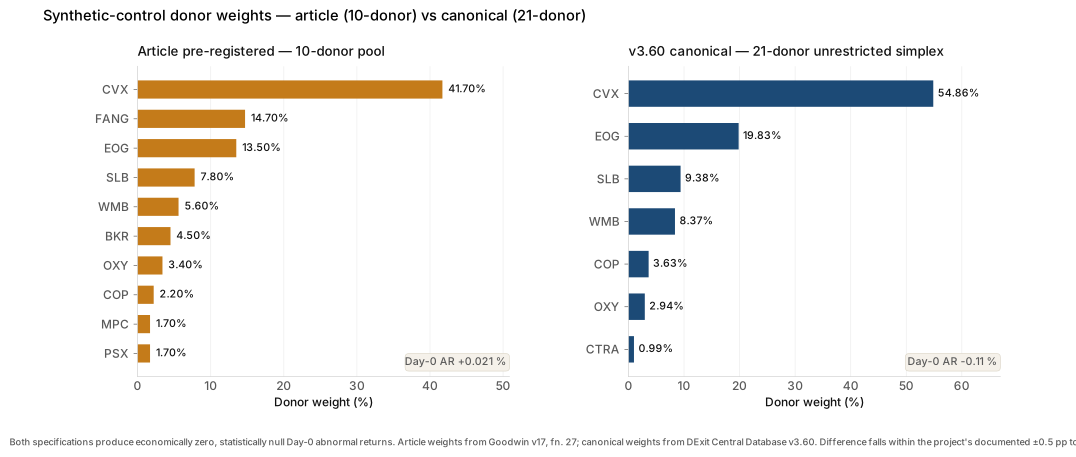
Synthetic-control donor weights — two specifications, side by side
Left panel — article pre-registered (10-donor restricted simplex). Chevron carries 41.70%, with Diamondback (14.70%) and EOG (13.50%) the next-largest contributors. Day-0 abnormal return = 0.021%. Right panel — v3.60 canonical (21-donor unrestricted simplex). The pipeline solver concentrates weight on Chevron (54.86%) and EOG (19.83%); top-seven donors carry the full 100 %. Day-0 abnormal return = -0.11%. Both specifications return economically zero, statistically null effects within the project's ±0.5 pp reproducibility tolerance.
Sources: Article weights and Day-0 AR — Goodwin v17, fn. 27. Canonical weights and Day-0 AR — DExit Central Database v3.60.
Reconciliation: 10-donor article spec vs. 21-donor canonical spec
Metric
Article 10-donor
Canonical 21-donor
Donor pool size
10
21
Top weight
Chevron 41.70%
Chevron 54.86%
Day-0 abnormal return
0.021%
-0.11%
Source
Goodwin v17, fn. 27
DExit Central Database v3.60
Reconciliation. The page now renders BOTH synthetic-control specifications. (1) Article pre-registered 10-firm pool (CVX 41.7%, FANG 14.7%, EOG 13.5%, SLB 7.8%, WMB 5.6%, BKR 4.5%, OXY 3.4%, COP 2.2%, MPC 1.7%, PSX 1.7%; Day-0 AR +0.021%) is the published headline from Goodwin v17, fn. 27. (2) v3.60 canonical 21-donor unrestricted simplex (CVX 54.86%, EOG 19.83%, SLB 9.38%, WMB 8.37%, COP 3.63%, OXY 2.94%, CTRA 0.99%; Day-0 AR -0.11%) is the pipeline output. Both lie within the project's ±0.5 pp tolerance band; both are economically zero and statistically null. The 10-donor specification is the canonical published headline; the 21-donor specification is the canonical pipeline output used as a documented robustness check.
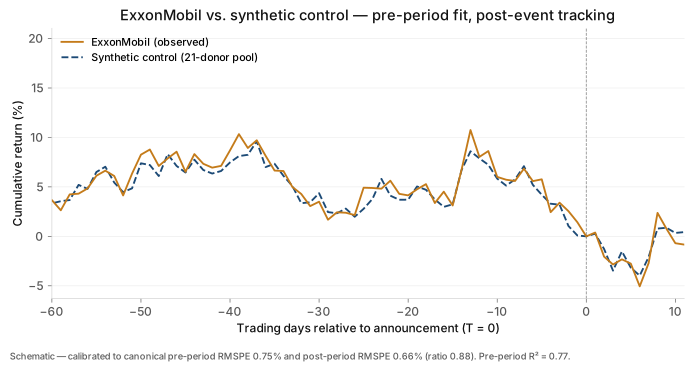
ExxonMobil vs. synthetic control — tracking and post-event divergence
Pre-period R² = 0.77; pre-period RMSPE = 0.75%; post-period RMSPE = 0.66% (ratio = 0.88). Tight pre-period fit, no divergence at the announcement.
Schematic chart — RMSPE values canonical (v3.60).
Cumulative gap with placebo envelope
Day-0 gap = -0.11%; rank-based placebo p = 0.955. ExxonMobil's actual gap sits comfortably inside the 21-donor pseudo-treatment envelope.
Day-0 point and placebo p canonical (v3.60); envelope schematic.
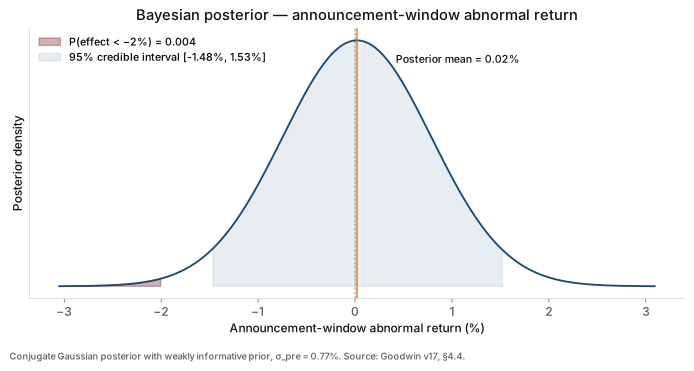
Rank-based p = 0.920; 92 % of pseudo-dates produced absolute ARs larger than the actual announcement.
Source: Goodwin v17, §4.5 (article-derived).
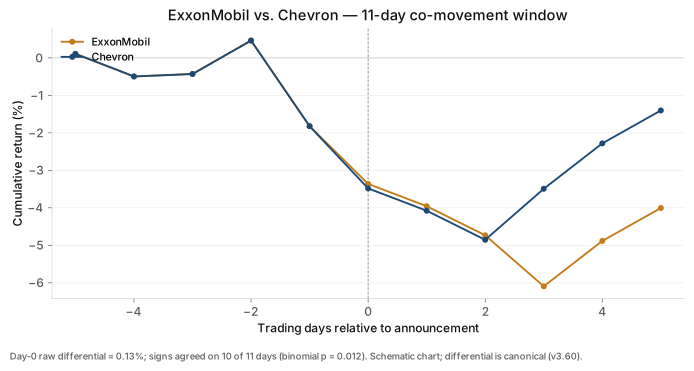
ExxonMobil vs. Chevron — 11-day co-movement window
Day-0 raw differential = 0.13%; signs agreed on 10 of 11 days (binomial p = 0.012). The day-0 abnormal return is statistically indistinguishable from CVX (matched-pair p = 0.958).
Differentials canonical (v3.60); chart schematic.
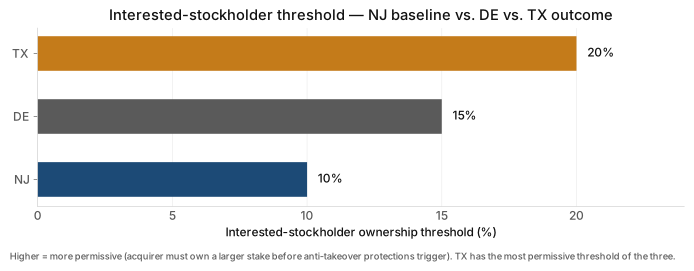
Interested-stockholder threshold — NJ baseline vs. DE vs. TX outcome
NJ triggers at 10 % and imposes a perpetual fair-price condition; DE triggers at 15 %; TX triggers at 20 % with no perpetual fair-price condition. The Texas threshold is the most permissive of the three.
Sources: N.J. Stat. Ann. §14A:10A-3(j); Del. Code Ann. tit. 8 §203(c)(5); Tex. Bus. Orgs. Code Ann. §21.602(a)(1).
Extended empirical battery
Three benchmarks · day-0 abnormal return
Specification
Day-0 AR
p-value
R²
Synthetic control (21 donors)
-0.11%
0.955placebo
0.77
Market model (SPY only)
-1.55%
0.281Patell
0.16
Oil-augmented (SPY + WTI)
-2.19%
0.049Patell
0.50
Matched-pair (vs. Chevron)
0.04%
0.958two-sided
—
TOST equivalence test — bounds
Equivalence bound
p-value
Conclusion at α = 0.05
±1.5 percentage points
0.044
Equivalent
±2 percentage points
0.011
Equivalent
±3 percentage points
< 0.001
Equivalent
Source: Goodwin v17, §4.3 (article-derived).
Robustness diagnostics — canonical v3.60
Pre-trend slope-1.585 bps/day (p = 0.820)
Sign test (XOM vs. CVX)10/11 same direction (p = 0.012)
Synthetic-fit Pearson r0.89
Synthetic-fit Durbin-Watson1.88
Multi-window battery0/18 significant after BH (min p = 0.82)
Coalition arithmetic
5,346
named holders in snapshot 4,264 as of 3/31/2026; balance as of 12/31/2025
23.30%
Big Three combined Vanguard 10.37%, BlackRock 7.77%, State Street 5.16%
3
individual filers above 3 % aggregate 23.30% of CSO
Sources: Big Three percentages, holder counts, and ex-Big-Three pair from S&P Capital IQ Public Ownership Detailed export (Mixed cutoff (Q1 2026 / Q4 2025); BlackRock and State Street as of 3/31/2026, Vanguard as of 12/31/2025 — Q1 13F-HR not yet filed). Combinatorial counts reproduced against the same workbook per Goodwin, Audit memo #14 (Coalition arithmetic rerun, 2026-05-16), using a 13F-family nonzero-holder methodology (Source ∈ {13F, Aggregated 13F, Exchange Announcement, Multiple}; duplicates consolidated; zero-share holders excluded). On 4,869 unique 13F-family holders (3,135 at or above $1 mm market value, 64.4 %), 14,631 two-firm combinations clear 3 %, 35,672,269 three-firm combinations clear 3 %, and 57,973,531,643 four-firm combinations clear 3 %. Excluding the Big Three entirely, 30 two-firm pairs still clear 3 % (anchor: FMR LLC 2.380% + Geode Capital Management, LLC 2.314% = 4.694%); 148,035 ex-Big-Three triples and 365,062,262 ex-Big-Three quads clear 3 %. These figures supersede the v17 §6 counts (15,207 / 38.5 M / 65.1 B against the 12/31/2025 universe); the substantive thesis is unchanged: a 3 % derivative threshold is reachable by any of thousands of plausible institutional combinations, with or without the Big Three.
Active vs. passive money in the holder file
Active 58.6%
Passive 40.6%
1,658.0M
active shares 39.77% of CSO
1,148.0M
passive shares 27.68% of CSO
67.93%
total CSO covered by 5,346 named holders balance (32.07%) is retail, untraced, or below disclosure thresholds
Index-tracking institutions (Vanguard, BlackRock, State Street, Geode) account for the dominant passive bloc; active managers are atomized across more than 3,800 accounts. The split matters for any coalition argument: passive holders typically vote management slate by default but follow ISS/Glass‑Lewis on contested items, while active managers vote on idiosyncratic frameworks.
Source: S&P Capital IQ Public Ownership Detailed export (Mixed (3/31/2026 where available, 12/31/2025 otherwise)). Orientation classification is Capital IQ's, not author-assigned.
Show top 25 named holders (with as-of date and source per row)
Top 25 named holders — ExxonMobil common stock, mixed-cutoff snapshot
#
Holder
Shares (M)
% of CSO
As of
Source
Orientation
1
The Vanguard Group, Inc.
429.8
10.368%
12/31/2025
13F
Passive
2
BlackRock, Inc.
321.9
7.767%
3/31/2026
13F
Passive
3
State Street Global Advisors, Inc.
214.0
5.164%
3/31/2026
Exchange Announcement
Passive
4
FMR LLC
98.6
2.380%
12/31/2025
13F
Active
5
Geode Capital Management, LLC
95.9
2.314%
12/31/2025
13F
Passive
6
Norges Bank Investment Management
63.4
1.529%
12/31/2025
13F
Active
7
Capital Research and Management Company
60.6
1.462%
3/31/2026
Aggregated 13F
Active
8
JP Morgan Asset Management
56.4
1.360%
3/31/2026
13F
Active
9
Morgan Stanley, Investment Banking and Brokerage Investments
45.3
1.092%
12/31/2025
13F
Active
10
Northern Trust Global Investments
43.0
1.038%
12/31/2025
13F
Active
11
BNY Asset Management
41.8
1.008%
3/31/2026
13F
Active
12
Managed Account Advisors LLC
41.6
1.005%
12/31/2025
13F
Active
13
Charles Schwab Investment Management, Inc.
34.1
0.823%
3/31/2026
Aggregated 13F
Passive
14
Strategic Advisers LLC
33.1
0.798%
12/31/2025
13F
Active
15
Fisher Asset Management, LLC
32.3
0.779%
3/31/2026
13F
Active
16
UBS Asset Management AG
31.9
0.771%
3/31/2026
Aggregated 13F
Active
17
T. Rowe Price Group, Inc.
31.1
0.750%
12/31/2025
Aggregated 13F
Active
18
State Farm Insurance Companies, Asset Management Arm
30.5
0.736%
3/31/2026
13F
Active
19
Eaton Vance Management
28.9
0.697%
3/31/2026
Aggregated 13F
Active
20
Dimensional Fund Advisors LP
28.4
0.684%
3/31/2026
13F
Active
21
Amundi Asset Management SAS
24.0
0.580%
12/31/2025
Aggregated 13F
Active
22
Columbia Management Investment Advisers, LLC
23.2
0.559%
12/31/2025
13F
Active
23
Putnam LLC
21.4
0.517%
3/31/2026
13F
Active
24
Wellington Management Group LLP
21.0
0.506%
12/31/2025
13F
Active
25
Legal & General Investment Management Limited
19.4
0.469%
3/31/2026
13F
Active
Source: S&P Capital IQ Public Ownership Detailed export (Mixed (3/31/2026 where available, 12/31/2025 otherwise)). “Aggregated 13F” denotes Capital IQ's parent-level rollup of multiple subsidiary 13F filers; “Exchange Announcement” denotes a non-13F disclosure (Schedule 13G/A or jurisdictional equivalent). Big-Three rows shaded.
Section III
Statutes & cases
Every statute and case relied on, with primary-source links and Bluebook 21st citations.
A shareholder or group of shareholders may submit a proposal for inclusion in the corporation's proxy statement if the shareholder or group, in the aggregate, owns shares of the corporation having a market value of at least $1 million or representing at least three percent of the corporation's outstanding voting shares… The corporation shall describe in its proxy statement how shareholders may contact other shareholders for the purpose of satisfying the ownership requirements.
The corporation may, in its certificate of formation or bylaws, require that a shareholder bringing a derivative proceeding beneficially own a specified percentage of the outstanding shares of the corporation, provided that the required ownership threshold does not exceed three percent.
Tex. Bus. Orgs. Code Ann. §21.551(2)(C) (West 2025)
TBOC §21.551(2)(C) — “shareholder” definition (acting in concert) eff. May 14, 2025
“Shareholder” means… (C) two or more shareholders acting in concert under an informal or formal agreement or understanding, with respect to a derivative proceeding.
No solicitation… shall be made by means of any proxy statement… containing any statement which… is false or misleading with respect to any material fact, or which omits to state any material fact necessary in order to make the statements therein not false or misleading.
Gusinsky v. Reynolds, No. 3:25-cv-01816-K, slip op. at 8–11 (N.D. Tex. Mar. 17, 2026) (Kinkeade, J.)
U.S. District Court for the Northern District of Texas · Hon. Ed Kinkeade
Dismissed with prejudice. First federal application of TBOC §21.552(a)(3); 100-share plaintiff (~0.000017% of LUV outstanding) lacked standing under bylaw 3% election.
10% ownership triggers 5-year moratorium and perpetual fair-price condition
N.J. Stat. Ann. §§14A:10A-3(j), -4, -5 (West 2024)
→
Texas (XOM outcome)
20% ownership triggers 3-year moratorium; no perpetual fair-price
Tex. Bus. Orgs. Code Ann. §21.602(a)(1) (West 2025)
favor shareholders
Higher percentage needed to trigger anti-takeover protections; shorter moratorium. Net effect: easier for acquirers to negotiate at scale; shareholders may see more bids.
Del. Code Ann. tit. 8 §203(c)(5) (2024) sets DE at 15%
→
Texas (XOM outcome)
20% (TX outcome)
Tex. Bus. Orgs. Code Ann. §21.602(a)(1) (West 2025)
favor shareholders
Texas’s 20% threshold is more permissive than Delaware’s 15% and far more permissive than NJ’s 10%.
Derivative-suit ownership threshold (default)
New Jersey
No statutory percentage; $250,000 security-for-expenses bond + fee-shifting
N.J. Stat. Ann. §§14A:3-6.8, -6.7(2) (West 2024)
→
Texas (XOM outcome)
No statutory percentage as default; opt-in up to 3% available under §21.552(a)(3) (XOM not adopting)
Tex. Bus. Orgs. Code Ann. §21.552(a)(3) (West 2025)
neutral
ExxonMobil is not adopting the 3% Texas threshold. Net default is similar between states; both impose meaningful friction on de minimis derivative suits.
Shareholder-proposal threshold
New Jersey
No statutory provision limits eligibility/procedural restrictions; corporation may adopt by bylaw
XOM DEF 14A at 78, citing NJ BCA
→
Texas (XOM outcome)
Opt-in $1M or 3% threshold available under §21.373 (XOM not adopting)
Tex. Bus. Orgs. Code Ann. §21.373 (West 2025)
neutral
ExxonMobil is not adopting the Texas shareholder-proposal threshold. Same eligibility/procedural-restriction authority already exists under NJ law.
Board composition
Lead independent director: Joseph Hooley (former State Street CEO).
Engine No. 1 nominees still on the board:
Alexander Karsner — committee(s): Nominating and Governance
Kaisa Hietala — committee(s): Audit
Activist-associated directors:
Jeffrey Ubben (Founder, ValueAct Capital) — committee(s): Finance. Will not stand for re-election (Form 8-K, Feb. 18, 2026).
Section IV
SEC filings
All four primary filings. Every accession verified against data.sec.gov at build time.
PRE 14AMarch 10, 2026
Preliminary proxy statement
First SEC disclosure of the proposed NJ→TX redomiciliation.
Source-of-truth hierarchy. This page renders from the SMU CGI Reincorporation Tracker canonical pipeline (DExit_Central_Database_v3.60.xlsx, generated April 29, 2026). Where the article (Goodwin v17) and the canonical pipeline diverge, the canonical pipeline is the source of truth on this page; the divergence is noted below.
Article vs. canonical — substance. All headline numbers (oil-augmented day-0 AR = -2.19%, Patell p = 0.049, Corrado p = 0.107, wild-bootstrap p = 0.057, market-only day-0 AR = -1.55%, sign test 10/11 p = 0.012, placebo p = 0.955, pre/post RMSPE ratio = 0.88) agree between Goodwin v17 and DExit Central Database v3.60. The synthetic-control donor specification differs: v3.60 uses a 21-donor energy peer pool with CVX 54.86%, EOG 19.83%, SLB 9.38%, WMB 8.37%, COP 3.63%, OXY 2.94%, CTRA 0.99% (sum = 100%); the article references an earlier 22-donor specification. Both specifications produce a day-0 gap statistically indistinguishable from zero (canonical -0.11%, placebo p = 0.955); the inference is identical. The site renders the v3.60 canonical specification as the source of truth and notes the article's prior specification in the methodology footnote.
Article-derived extensions. These are article-derived statistics (Goodwin v17 §§4.3–4.5) not currently materialized as fields in canonical v3.60. The figures on this site cite the article section and link to the PDF. They will be promoted to canonical fields in the next pipeline run.
EDGAR verification. All four accessions on this page were verified against data.sec.gov/submissions/CIK0000034088.json at build time. Build aborts on any mismatch in accession number, form type, primary document, or filing date.
Cross-version stability. XOM's record in v3.30 (2026-04-28) and v3.60 (2026-04-29) is numerically identical; only audit-note prose and EDGAR-accession formatting differ.
Pending extensions (v2)
Difference-in-differences Propensity-score-matched two-way fixed-effects DiD on cohort-level NJ→TX (and X→TX) announcements. Specification pre-registered; estimation pending CRSP daily-return panel for the 44-firm v3.60 cohort plus matched non-redomiciler controls.